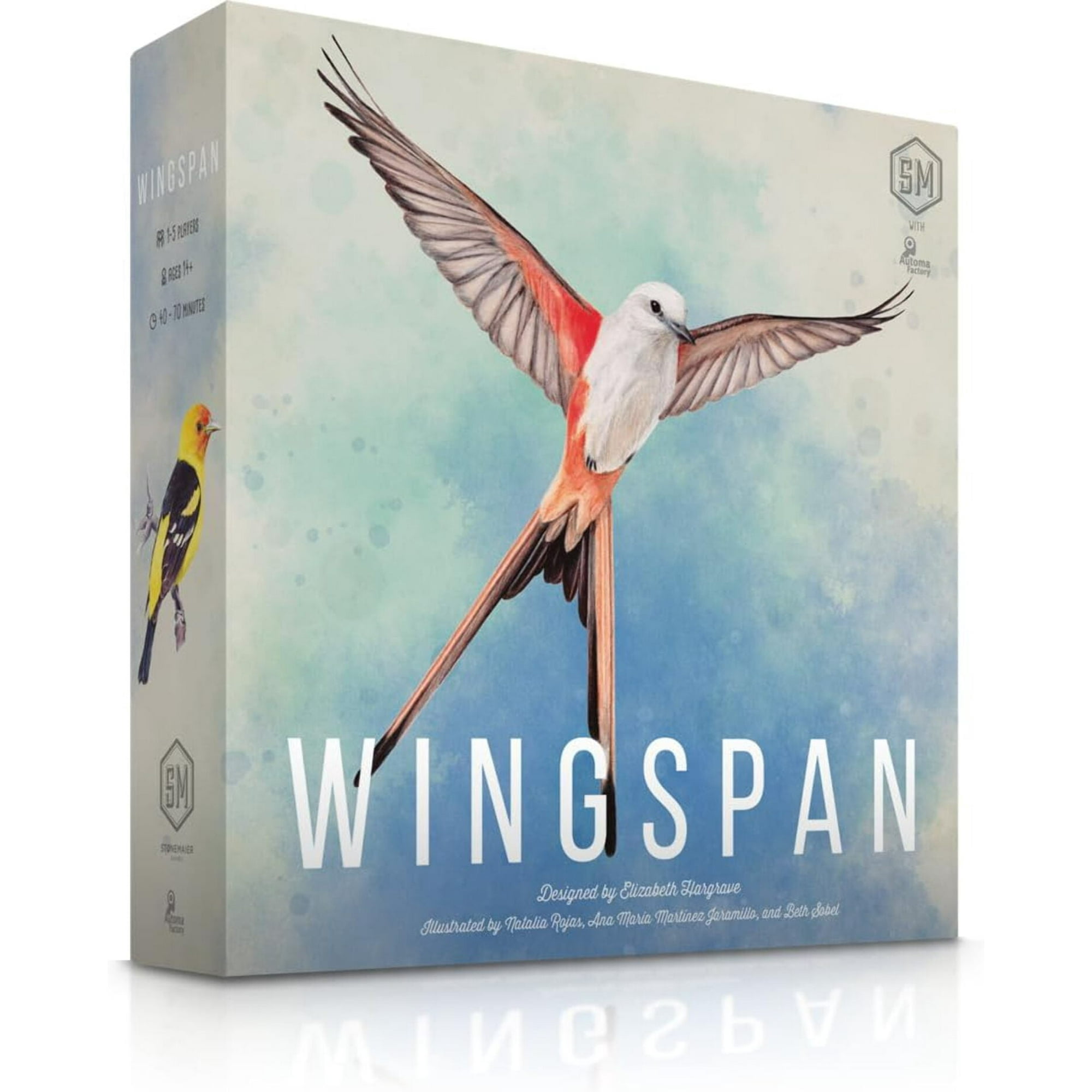
Stonemaier Games: Wingspan (Base Game) by Elizabeth Hargrave | A Relaxing, Award-Winning Strategy Board Game About Collecting Birds for Adults and Family | 1-5 Players, 70 Mins
View on AmazonA board game about birds sounds like the most boring gift pitch imaginable. I thought the same thing until someone brought Wingspan to a game night, and we ended up playing it three times in a row. There's something about this game that just clicks, even with people who normally gravitate toward party games or don't play board games at all.
Wingspan is a card-driven strategy game where you're building a bird sanctuary. Each turn, you play bird cards into one of three habitats, collect food tokens, lay eggs, or draw more cards. It plays 1 to 5 people in about 40 to 70 minutes, and there's a solo mode that's surprisingly good.
Why People Love It
⭐ Gorgeous production quality: detailed bird cards with real illustrations and facts
⭐ The dice tower is a literal birdhouse, and the eggs are pastel-colored miniatures
⭐ Strategic depth without the cutthroat vibe of most competitive games
⭐ Easy to teach in about 15 minutes, even to non-gamers
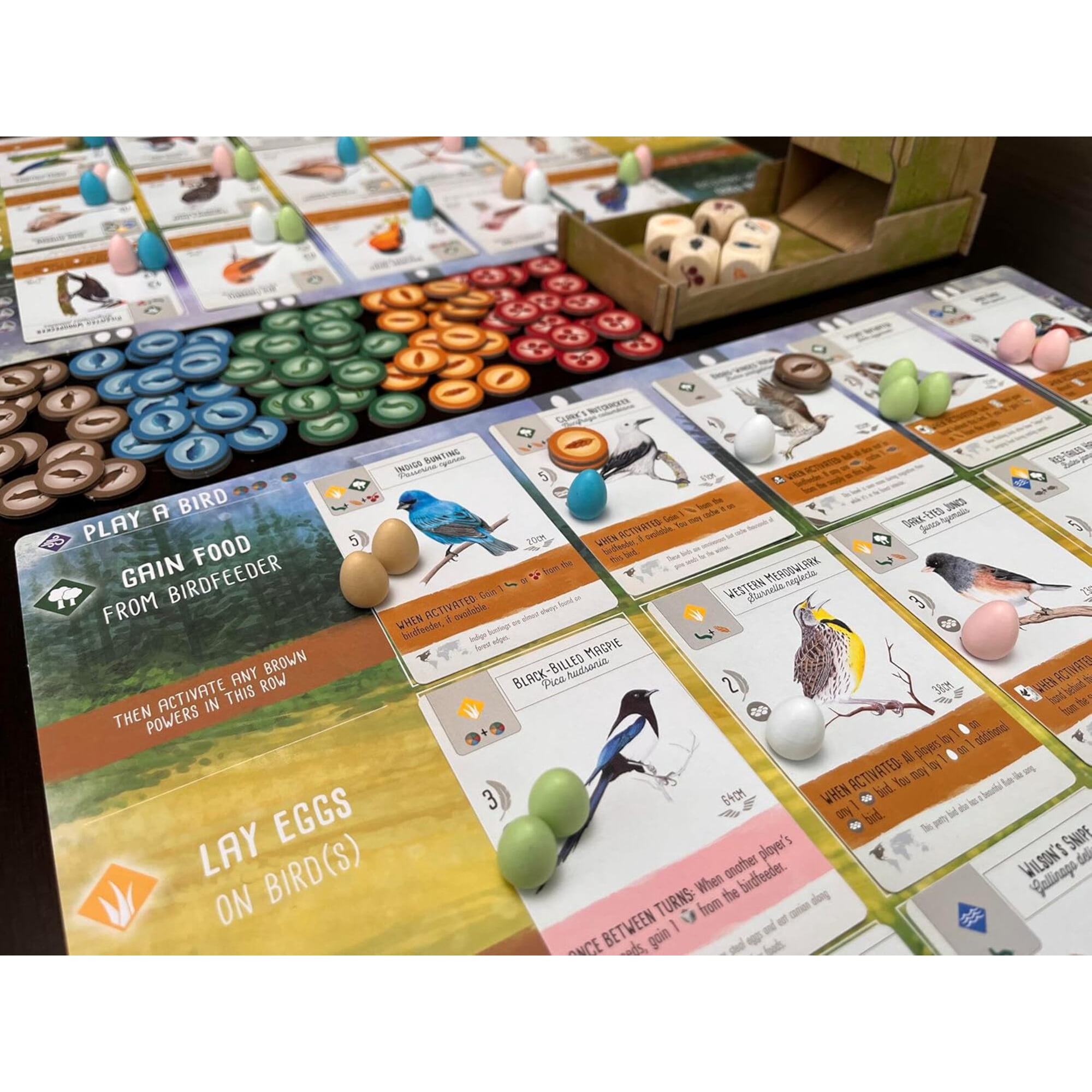
The art is what hooks people first. Every one of the 170 bird cards features a unique watercolor-style illustration with a real wingspan measurement and habitat preference. You'll find yourself reading the flavor text and Googling birds you've never heard of. The components feel premium too, from the thick cardboard player mats to the chunky food tokens.
How a Game Actually Plays
Each round gives you a limited number of turns, and that number decreases as the game progresses. In the first round you have eight turns, then seven, six, and five. This creates a natural arc where early rounds are about building your engine and later rounds are about squeezing the most points out of what you've built.
The three habitats on your player mat each do something different. The forest habitat lets you gain food (needed to play bird cards). The grassland lets you lay eggs (which are both points and a resource). The wetland lets you draw more bird cards. As you place birds in a habitat, you unlock more powerful versions of that action, so your engine becomes more productive over time.
What makes the strategy satisfying is that there's no single winning formula. One game you might focus on birds with large wingspans for bonus points. Next game you might chase birds that trigger special powers when other players take certain actions. The variety across 170 cards means no two games play out the same way.
Who Actually Enjoys This
I've played Wingspan with serious board gamers, with my parents, and with friends who normally only play Codenames or Cards Against Humanity. It works with all of them, though for different reasons.
Serious gamers appreciate the engine-building and the card combos. Casual players like the bird theme, the tactile components, and the fact that they're building something rather than tearing down other players' plans. Non-gamers respond to the art and the educational angle (you genuinely learn things about birds).
The solo mode deserves its own mention. You play against an automated opponent called the "Automa" that draws from its own simplified deck. It's well-designed enough that you can have a satisfying game by yourself on a quiet evening. For someone who just moved and might not have local friends to play with yet, that matters.
Couples especially seem to gravitate toward this game. It plays well at two players, which is where a lot of strategy games start to feel thin. The pacing stays tight, the choices stay interesting, and games finish in about 45 minutes.
How It Compares to Other Gateway Games
If you're deciding between Wingspan and other popular picks like Ticket to Ride, Catan, or Azul, here's how they stack up.
Ticket to Ride is simpler and more accessible but has less strategic depth. Catan is more interactive (trading, blocking) but can feel frustrating when the dice don't go your way. Azul is gorgeous and plays quickly but lacks the thematic richness.
Wingspan sits right above all of these in complexity but doesn't cross the line into intimidating territory. It takes about one game to learn and feels rewarding by the second play. If the person you're buying for already owns Ticket to Ride or Catan and wants something with a bit more to think about, Wingspan is the natural next step.
Expansions Worth Knowing About
Stonemaier has released several expansions: European, Oceania, and Asia. The European expansion adds new birds and powers. Oceania adds a new resource (nectar) and refreshes the food mechanics. Asia introduces a cooperative mode for two-player teams.
You don't need any expansions to enjoy the base game. There's plenty of replay value in the box as-is. But if you know the recipient already owns Wingspan, one of the expansions makes a perfect follow-up gift. The Oceania expansion is the most popular for a reason: it adds the most mechanical variety without overcomplicating things.
The Downsides
The first game takes longer than you'd expect. Despite the relatively simple rules, there are enough moving pieces that your initial playthrough will probably run 90 minutes or more as everyone figures out the card synergies. After that, it speeds up considerably.
There's also limited player interaction. You're mostly building your own engine and occasionally competing for end-of-round goals. If your group likes games where you're directly messing with each other's plans, Wingspan might feel too peaceful.
At $65, it's pricier than most mainstream board games. You're paying for the component quality and the design, and both are worth it, but it's still a lot compared to picking up a card game for $15.
Setup and teardown take a bit of time too. Sorting food tokens, shuffling the bird deck, organizing the bird tray... you're looking at 5 to 10 minutes of prep before you play and another 5 to put everything away. It's not a grab-and-go game.
Who Should Get This
Anyone who just moved into a new place and needs something to do when friends come over. It's a fantastic "couple's game night" pick, and it works equally well with a group. Also perfect for the person who keeps saying they want to get into board games but doesn't know where to start.
As a housewarming gift specifically, Wingspan fills a gap that new homes always have: things to do with guests. Having a great board game on the shelf means the first time friends come over doesn't default to "let's just watch something."
Gift-Wrapping Tips
The box is a standard board game size and wraps easily. If you want to add a small touch, include a handwritten card suggesting you come over to teach them how to play. That turns the gift into a hangout, which is really what a housewarming is about.
Final Verdict
Wingspan is one of those rare games that appeals to hardcore strategy fans and casual players at the same time. It looks beautiful on a shelf, plays smoothly once you learn it, and gives your new home something to gather around. As a housewarming gift, it's unexpected and memorable.
Flippe Gift Rating: 4.3 / 5 (Very Good)